Discussing attributes, postmodernism, reason and rationality, Ross Atkinson’s “Transversality and the Role of the Library as Fair Witness” took me back to philosophy classes I had as an undergrad. Beyond bringing me a bit of nostalgia, the article also encapsulates libraries’ reasons for existence. By reducing what libraries “are” down to two attributes, plurality and authority, Atkinson pinpoints the tension felt within libraries being pulled in two different directions. We want to simultaneously provide all information to all people, while maintaining accuracy and trustworthiness of our resources.
As I read about transversality, I started thinking about how libraries have to work to transcend all of the political bullarky in order to be a fair witness. It's a big challenge. Speaking of challenges, Atkinson says that "It is a primary capacity of reason, therefore, to create connections among concepts or positions that do not, in fact, connect well, providing the ability (or tolerance) to live and work in the presnece of even irreconcilable contradictions" (2005, 181). This quote helps me realize that I am definitely reason-challenged right now, and therefore having difficultly making the connection between ...Fair Witness and Attention Web Designers.
Both are great articles. I found the Lindgaard, et. al., article to be very interesting. First impressions of websites certainly do make a big difference. When I first visit a web site, I have an immediate reaction to it, and the little web surfer in my head says either "this is going to be good," or "move on, this is worthless!" However, Lindgaard seems to imply that aesthetics is more important than usability. For me, usability is part of the visual appeal. Usability is beautiful. From what I understood of the study described, the experiment was performed with a program to make the pages look as though they were displayed with IE, though the users weren't actually clicking through the Internet. I wonder, does this affect download time? I want pleasing colors, but I also want clear content and speed of information over snazzy, distracting animations and graphics. Jakob Nielson says that your page should load quickly: "The one-second response-time limit is required for users to feel that they are moving freely through the information space" (Nielson 2000, 48). Lindgaard's study showing that you have 50 ms to make a good impression rings true...and, part of that first impression is presenting your information quickly. Your site should be attractive (Great Guru Neilson's website--not so attractive in my opinion), but not by sacrificing downloading time.
Nielson, Jakob. 2000. Designing web usability. Indianapolis: New Riders Publishing.
Sunday, September 24, 2006

Sunday, September 17, 2006
Metadata of mega-importance?
First, what is the RFD tag for "dang, you, Amanda!"? I followed her suggestion to checkout bloglines.com, even though I really should have been writing my own blog. I quickly got sucked into that world and completely lost track of the time. Sometimes with this class I feel like I'm beginning an addiction. It starts with just a little bit, just something you do on the weekends (not class, but the interesting links you visit related to class). Then, you need a little more, a little mid-week pick-me up. Soon, you're doing it every day, every chance you get, trying to hide it from your family. I only realized how long I had been reading RSS Feeds--feeds of sites that I never visit, by the way, but just subscribed to because they were a quick option during registration--when my husband walked through. First, it was the image generators, then the anuice site...Now he no longer even asks, "this is what you're doing for your MLIS?"
Of course, he doesn't walk by when I'm reading the Gradman article, so that I could say, "Gee, have you ever thought about how much expertly-analyzed information is hidden in library catalogs everywhere, inaccessible to the myriad of search engines available? Wouldn't it be truly amazing and wonderful if someone searching for information on the Internet for, say, gardening, also got links to several books available at their local library?"
Unfortunately, much of the information housed within library catologs remains part of the "hidden web," as Gradman refers to it. Making those bibliographic records more accessible to the WWW would be an excellent move for libraries. We still hear those "why do we need libraries, now that we have the Internet?" comments; making our resources more findable would be a new way to market to those thinkers. A simple Google search for The Life of Pi of course pulls up links to Amazon, Powells.com, and several review sites. However, if I were interested in reading this book, I might also like to know that Tulsa City-County Library has over 20 copies of this book, at least eight of which are currently available, and that I could reserve online tonight and pick it up before online booksellers could possibly deliver it to me.
I think we must start working toward ways to escape the "golden cage," of which Gradman speaks. His proposal for FRBR seems reasonable, but I don't know enough about cataloging to really understand all of the multitude of issues involved. Undoubtably, translating all those records would be a chore. Also, I know that there are many metadata schemas currently being used and developed, and I certainly don't have the experience to say that FRBR would work better than any others. I've read about RDF, XML, TEI, EAD, DC, and others, but I think this is the first time I've heard of FRBR.
After reading his article, I did go straight to Amazon and add some XML tutorial books to my wishlist :}
With visions of magical metadata swimming in my head, I began reading Mohamed's "The Impact of Metadata in Web Resources Discovering," only to learn that his study shows that metadata has no significant effect on the rank order of web pages in certain search engines! How can this be possible? If you were to ask me what I remembered most from my Organization of Information class, I would have to say "the word METADATA!" I have to wonder if perhaps the importance of metadata goes beyond search engine rank order. Maybe it has more to do with our taking baby-steps ever closer to the Semantic Web. Or, maybe Mohamed should have just used Google, like the rest of us ;)
Of course, he doesn't walk by when I'm reading the Gradman article, so that I could say, "Gee, have you ever thought about how much expertly-analyzed information is hidden in library catalogs everywhere, inaccessible to the myriad of search engines available? Wouldn't it be truly amazing and wonderful if someone searching for information on the Internet for, say, gardening, also got links to several books available at their local library?"
Unfortunately, much of the information housed within library catologs remains part of the "hidden web," as Gradman refers to it. Making those bibliographic records more accessible to the WWW would be an excellent move for libraries. We still hear those "why do we need libraries, now that we have the Internet?" comments; making our resources more findable would be a new way to market to those thinkers. A simple Google search for The Life of Pi of course pulls up links to Amazon, Powells.com, and several review sites. However, if I were interested in reading this book, I might also like to know that Tulsa City-County Library has over 20 copies of this book, at least eight of which are currently available, and that I could reserve online tonight and pick it up before online booksellers could possibly deliver it to me.
I think we must start working toward ways to escape the "golden cage," of which Gradman speaks. His proposal for FRBR seems reasonable, but I don't know enough about cataloging to really understand all of the multitude of issues involved. Undoubtably, translating all those records would be a chore. Also, I know that there are many metadata schemas currently being used and developed, and I certainly don't have the experience to say that FRBR would work better than any others. I've read about RDF, XML, TEI, EAD, DC, and others, but I think this is the first time I've heard of FRBR.
After reading his article, I did go straight to Amazon and add some XML tutorial books to my wishlist :}
With visions of magical metadata swimming in my head, I began reading Mohamed's "The Impact of Metadata in Web Resources Discovering," only to learn that his study shows that metadata has no significant effect on the rank order of web pages in certain search engines! How can this be possible? If you were to ask me what I remembered most from my Organization of Information class, I would have to say "the word METADATA!" I have to wonder if perhaps the importance of metadata goes beyond search engine rank order. Maybe it has more to do with our taking baby-steps ever closer to the Semantic Web. Or, maybe Mohamed should have just used Google, like the rest of us ;)
Saturday, September 09, 2006
Where is my "handy personal memory extension"?
For years, I have been asking when I would be able to buy a flash drive that I could plug directly into my temple, as a memory extension. Now, reading "Memex at 60: Internet or iPod?," by Richard Veith, I learn that this idea has been around for over 60 years. I admit it--I'm spoiled by my laptop with wi-fi, my iPod, my PDA, my flash drive, and my high speed Internet connection at home, work and school. Therefore, I'm taking this news a little bit like I took the news that flying cars have been possible for a long time (http://en.wikipedia.org/wiki/Flying_car), but I just can't have one--that is, I feel a bit betrayed.
Yes, I have all these other gadgets, but they don't make up for my poor memory. I almost never delete email, just so I can go back and try to remember the strands of digital conversations. That is not, however, "an extension of one's own memory," as Veith calls the idea of the Memex (2006, 1239). What I need is the working version of Gordon Bell's MyLifeBits (see http://research.microsoft.com/barc/mediapresence/MyLifeBits.aspx), that attempts to store everything he sees or hears (Veith 2006, 1240).
I guess until I can buy a MyLifeBits device on Amazon for $19.99, I'll have to make do with my latest memory-extension tool: Google Desktop (http://127.0.0.1:4664/&s=r_07j9cPamQVuUuKgeqd4zb1IkA&q=). I really just started trying to use it within the last week or so, and so far it seems to have promise. Basically, you have a little Google search bar on your desktop. When you want to find something, you just start typing in the search bar, and it finds it with the speed of a Google Internet search. This is perfect for quickly finding papers that I wrote two semesters ago. If it doesn't locate your word or phrase on your computer, it offers to search the Web. It's a great tool, but it still doesn't make up for an operator's failing memory. For instance, I just spent 10 minutes being very angry that Google desktop wasn't finding anything about Veith or Vaidhyanathan...then I remembered that I was on a different computer when I viewed those.
Consider that my segue into Vaidhyanathan. Like pieandaphasia, I found "the better they are, the more dangerous libraries can seem," to be a powerful quote (Vaidhyanathan 2004, 118). Reading "The Perfect Library," Chapter 8 of The Anarchist in the Library (http://www.amazon.com/gp/product/0465089852/ref=pd_rvi_gw_1/103-0961424-3623008?ie=UTF8), I appreciated the insight that cooler heads don't make the news or inspire rallying cries. When libraries in Oklahoma came under attack for certain books in the children's collections, the fact that the libraries offer hundreds of thousands of "mainstream" children's books wasn't really newsworthy. It was only the extreme voices that were heard, though I think the majority of staff and patrons had the enlightened Vaidhyanathan response of "Slow down. Think this through. Talk this out. Don't rush to judgment" (2004, 115). In this case, what I like to think of as the "better" libraries were offering a variety of children's books, with a broad collection that attempted to serve as many segments of the community as possible. Unfortunately, this made those libraries seem more dangerous. For those already inclined to think so, the whole situation only fueled public libraries' reputation as "dens of terrorists and pornographers" (2004, 119).
Though such attacks are discouraging, maybe we in the profession need the opportunity for righteous outrage occasionally, to help us keep our purpose in sight, to inspire us to be "heroes." Without the USA PATRIOT act, would we have the rallying cry of being radical, militant librarians? I mean, would we have buttons (https://www.ala.org/ala/oif/basics/basicrelatedlinks/radicalbutton.htm)?
Yes, I have all these other gadgets, but they don't make up for my poor memory. I almost never delete email, just so I can go back and try to remember the strands of digital conversations. That is not, however, "an extension of one's own memory," as Veith calls the idea of the Memex (2006, 1239). What I need is the working version of Gordon Bell's MyLifeBits (see http://research.microsoft.com/barc/mediapresence/MyLifeBits.aspx), that attempts to store everything he sees or hears (Veith 2006, 1240).
I guess until I can buy a MyLifeBits device on Amazon for $19.99, I'll have to make do with my latest memory-extension tool: Google Desktop (http://127.0.0.1:4664/&s=r_07j9cPamQVuUuKgeqd4zb1IkA&q=). I really just started trying to use it within the last week or so, and so far it seems to have promise. Basically, you have a little Google search bar on your desktop. When you want to find something, you just start typing in the search bar, and it finds it with the speed of a Google Internet search. This is perfect for quickly finding papers that I wrote two semesters ago. If it doesn't locate your word or phrase on your computer, it offers to search the Web. It's a great tool, but it still doesn't make up for an operator's failing memory. For instance, I just spent 10 minutes being very angry that Google desktop wasn't finding anything about Veith or Vaidhyanathan...then I remembered that I was on a different computer when I viewed those.
Consider that my segue into Vaidhyanathan. Like pieandaphasia, I found "the better they are, the more dangerous libraries can seem," to be a powerful quote (Vaidhyanathan 2004, 118). Reading "The Perfect Library," Chapter 8 of The Anarchist in the Library (http://www.amazon.com/gp/product/0465089852/ref=pd_rvi_gw_1/103-0961424-3623008?ie=UTF8), I appreciated the insight that cooler heads don't make the news or inspire rallying cries. When libraries in Oklahoma came under attack for certain books in the children's collections, the fact that the libraries offer hundreds of thousands of "mainstream" children's books wasn't really newsworthy. It was only the extreme voices that were heard, though I think the majority of staff and patrons had the enlightened Vaidhyanathan response of "Slow down. Think this through. Talk this out. Don't rush to judgment" (2004, 115). In this case, what I like to think of as the "better" libraries were offering a variety of children's books, with a broad collection that attempted to serve as many segments of the community as possible. Unfortunately, this made those libraries seem more dangerous. For those already inclined to think so, the whole situation only fueled public libraries' reputation as "dens of terrorists and pornographers" (2004, 119).
Though such attacks are discouraging, maybe we in the profession need the opportunity for righteous outrage occasionally, to help us keep our purpose in sight, to inspire us to be "heroes." Without the USA PATRIOT act, would we have the rallying cry of being radical, militant librarians? I mean, would we have buttons (https://www.ala.org/ala/oif/basics/basicrelatedlinks/radicalbutton.htm)?
Monday, September 04, 2006
Image Generators are Cool.
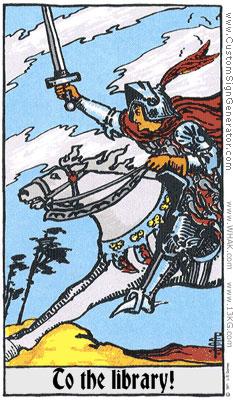
The blog, Learning 2.0, http://plcmcl2-things.blogspot.com/, recommended by Doctor Martens, suggested a little continuing education via image generators. Fun stuff--I wish I had more clever things to say on tarot cards!
To create your own 'fortune,' visit the link below to make a tarot card:
http://www.signgenerator.org/tarot/cards.asp
Thursday, August 31, 2006
"Big Mother" is watching you...
I'm thoroughly enjoying reading Ambient Findability, by Peter Morville. I am a huge fan of being able to find things easily, when you need them, and then finding them usable once you get there. The more I read about usability, findability, and the other things that make library (and other) services user-friendly, the less patience I have for things that aren't user friendly.
I'm not sure, however, how I feel about making *people* easily findable. The idea of fitting your young child with a locator while in a theme park (Morville 2005, 80) seems like a terrific idea. However, tracking your teenager with a GPS device as they drive to school, work, and social outings seems a little like spying. I read about this in Morville, and it did make me think about the length I would go to in order to protect/monitor my child.
By odd coincidence, this week I heard Technology Lets Parents Track Kids' Every Move on NPR <http://www.npr.org/templates/story/story.php?storyId=5725196>. This story provides a profile of a family that is actually using this technology.
It just makes me feel old. I generally think that I am a technophile. Then, I hear a story like this, and I hear myself saying things like "back in my day..."
Such parental tracking brings up all sorts of issues about trust, independence, privacy, psychology, and security in our modern society. It also makes me feel paranoid, even though Morville warns against it at this point (2005, 74).
I'm not sure, however, how I feel about making *people* easily findable. The idea of fitting your young child with a locator while in a theme park (Morville 2005, 80) seems like a terrific idea. However, tracking your teenager with a GPS device as they drive to school, work, and social outings seems a little like spying. I read about this in Morville, and it did make me think about the length I would go to in order to protect/monitor my child.
By odd coincidence, this week I heard Technology Lets Parents Track Kids' Every Move on NPR <http://www.npr.org/templates/story/story.php?storyId=5725196>. This story provides a profile of a family that is actually using this technology.
It just makes me feel old. I generally think that I am a technophile. Then, I hear a story like this, and I hear myself saying things like "back in my day..."
Such parental tracking brings up all sorts of issues about trust, independence, privacy, psychology, and security in our modern society. It also makes me feel paranoid, even though Morville warns against it at this point (2005, 74).
Link
Thursday, August 24, 2006
Gaming...education...nanotechnology...
Is it possible for technology and information access to help compensate for disadvantages caused by neglect, poverty, and/or general lack of opportunity?
Perhaps. What we know about childhood development and emergent literacy is this: positive, stimulating interaction creates and strengthens essential connections within the brain. Every experience that a child has affects the development of those connections. Such connections are being made at an astounding pace in an infant's brain...but through interactive, lifelong learning, they can continue to be developed and strengthened as an adult.
So, what does all this have to do with Learning by Design: Good Video Games as Learning Machines by James Paul Gee and We Live Here: Games, Third Places and the Information Architecture of the Future by Andrew Hinton?
As I reflected on the readings, I remembered a book I read several years ago that resonated deeply enough with me that I am still trying to get other people who "don't read science fiction" to read it. It's called The Diamond Age: or, a Young Lady's Illustrated Primer, by Neal Stephenson. This is science fiction, so it is set in the future. The story evolves around what nanotechnology could make possible, so it's not something we're going to see on our laptops for Christmas '06. The character I remember most in this book is Nell, a young girl who lives extreme poverty, doing her best to avoid abuse by her mother and her mother's string of loser boyfriends. Nell really doesn't stand a chance. Her older brother survives by belonging to a gang, and looks out for Nell as much as possible. She is not being sent to school, not being cared for, certainly not being valued or educated. Yet, her brother happens to rob a man who is carrying a special "book," which he gives to Nell. Nell's salvation through this book is what I remember. Of course, other characters played major parts and had parallel story lines...but those didn't really stick with me.
Gee has created a checklist of learning principles that are built into good games. He speaks of co-design, customization, identity, well-ordered problems, and cycles of expertise, sandboxes, and much more. Nell's "book" incorporated all of these. It's as though Gee read The Diamond Age (actually, I would bet that he has). Nell is not getting any positive interaction from any caring adult, and before she gets the book, she'd be lucky to survive to grow up to be a part-time prostitute like her mother. Yet, when she opens the book, a whole new world opens up to her--literally. We've talked about Second Life being an escape or another reality; this book goes far beyond all that. Based on nanotechnology, the book can create worlds to teach different skills, as though the reader were walking into a fairy tale or a textbook. Nell doesn't have to be able to read yet: the book adapts to match her current abilities and needs. It changes as she learns, and it works with her to develop essential survival skills in addition to intellectual skills. Of course, it's not the drill and practice that we see in so much educational technology currently available. It draws her into to various "games," in which she learns reading, writing, arithmetic, martial arts, and more. The book also gives Nell an identity and a relationship to a teacher within the game worlds that offer more stability, respect, and caring than anything she is likely to encounter in her home.
To bring us around to Hinton, Nell does basically begin to live within this book world as much as she can. Unfortunately for Nell, it is not her "third place," where she goes to have fun or socialize. It's really her first place, and her only safe place. Still, it offers the environment that Hinton recommends, creating the right conditions for Nell to give life to her education. The book offers sort of an "open architecture" that allows Nell to change the "reality" as she goes.
I think that one reason I was so intrigued by this book was the idea--the hope--that our advancing technology might in some way equalize the disparities in opportunity between rich and poor, educated and uneducated. Of course, the digital divide may only exasperate the disparities; that is the outcome most often discussed. However, if access to technology is made equitable, then the learning principles in games (listed by Gee) could be especially beneficial to different learning styles, to those with LD, and those labeled "at-risk." No, the warm glow of a a computer screen shouldn't (and couldn't) replace the kind, loving hug of a care-giver. I do think, however that development of technology in this area can lead to advancements beyond letting people live out the wish-fulfillment fantasies of choosing a particular body size or hair style, as in Second Life.
And there you have my slightly tangential musings on gaming and education.
Perhaps. What we know about childhood development and emergent literacy is this: positive, stimulating interaction creates and strengthens essential connections within the brain. Every experience that a child has affects the development of those connections. Such connections are being made at an astounding pace in an infant's brain...but through interactive, lifelong learning, they can continue to be developed and strengthened as an adult.
So, what does all this have to do with Learning by Design: Good Video Games as Learning Machines by James Paul Gee and We Live Here: Games, Third Places and the Information Architecture of the Future by Andrew Hinton?
As I reflected on the readings, I remembered a book I read several years ago that resonated deeply enough with me that I am still trying to get other people who "don't read science fiction" to read it. It's called The Diamond Age: or, a Young Lady's Illustrated Primer, by Neal Stephenson. This is science fiction, so it is set in the future. The story evolves around what nanotechnology could make possible, so it's not something we're going to see on our laptops for Christmas '06. The character I remember most in this book is Nell, a young girl who lives extreme poverty, doing her best to avoid abuse by her mother and her mother's string of loser boyfriends. Nell really doesn't stand a chance. Her older brother survives by belonging to a gang, and looks out for Nell as much as possible. She is not being sent to school, not being cared for, certainly not being valued or educated. Yet, her brother happens to rob a man who is carrying a special "book," which he gives to Nell. Nell's salvation through this book is what I remember. Of course, other characters played major parts and had parallel story lines...but those didn't really stick with me.
Gee has created a checklist of learning principles that are built into good games. He speaks of co-design, customization, identity, well-ordered problems, and cycles of expertise, sandboxes, and much more. Nell's "book" incorporated all of these. It's as though Gee read The Diamond Age (actually, I would bet that he has). Nell is not getting any positive interaction from any caring adult, and before she gets the book, she'd be lucky to survive to grow up to be a part-time prostitute like her mother. Yet, when she opens the book, a whole new world opens up to her--literally. We've talked about Second Life being an escape or another reality; this book goes far beyond all that. Based on nanotechnology, the book can create worlds to teach different skills, as though the reader were walking into a fairy tale or a textbook. Nell doesn't have to be able to read yet: the book adapts to match her current abilities and needs. It changes as she learns, and it works with her to develop essential survival skills in addition to intellectual skills. Of course, it's not the drill and practice that we see in so much educational technology currently available. It draws her into to various "games," in which she learns reading, writing, arithmetic, martial arts, and more. The book also gives Nell an identity and a relationship to a teacher within the game worlds that offer more stability, respect, and caring than anything she is likely to encounter in her home.
To bring us around to Hinton, Nell does basically begin to live within this book world as much as she can. Unfortunately for Nell, it is not her "third place," where she goes to have fun or socialize. It's really her first place, and her only safe place. Still, it offers the environment that Hinton recommends, creating the right conditions for Nell to give life to her education. The book offers sort of an "open architecture" that allows Nell to change the "reality" as she goes.
I think that one reason I was so intrigued by this book was the idea--the hope--that our advancing technology might in some way equalize the disparities in opportunity between rich and poor, educated and uneducated. Of course, the digital divide may only exasperate the disparities; that is the outcome most often discussed. However, if access to technology is made equitable, then the learning principles in games (listed by Gee) could be especially beneficial to different learning styles, to those with LD, and those labeled "at-risk." No, the warm glow of a a computer screen shouldn't (and couldn't) replace the kind, loving hug of a care-giver. I do think, however that development of technology in this area can lead to advancements beyond letting people live out the wish-fulfillment fantasies of choosing a particular body size or hair style, as in Second Life.
And there you have my slightly tangential musings on gaming and education.
Subscribe to:
Posts (Atom)
